Latest · Gold & Investing
American Silver Pseudo-Marks
Why eagle, head and letter devices can mislead collectors.
Why eagle, head and letter devices can mislead collectors.
Community records, labels, ownership and construction evidence.
Names, dates, photographs, inscriptions, genealogy and textile evidence.
Documentation, raking light, microscopy and professional conservation.
Directories, newspapers, maps, probate files, museums and family collections.
How stamp, decoration, clay, form, damage and comparable examples interact.
A material-by-material review of irreversible damage.
Signs, bins, ledgers, invoices, local directories and business addresses.
Letters, photographs, uniforms, service records and later memorial objects.
Front, back, sides, top, bottom, interior, marks, hardware, joinery, surface, damage and scale.
Estimates serve a sale strategy. Compare the exact object, condition, venue, fees and result.
Labels, photographs, correspondence and objects can authenticate one another when kept together.
A real label can be moved, copied, misunderstood or attached to an altered object. Validate the object and mark together.
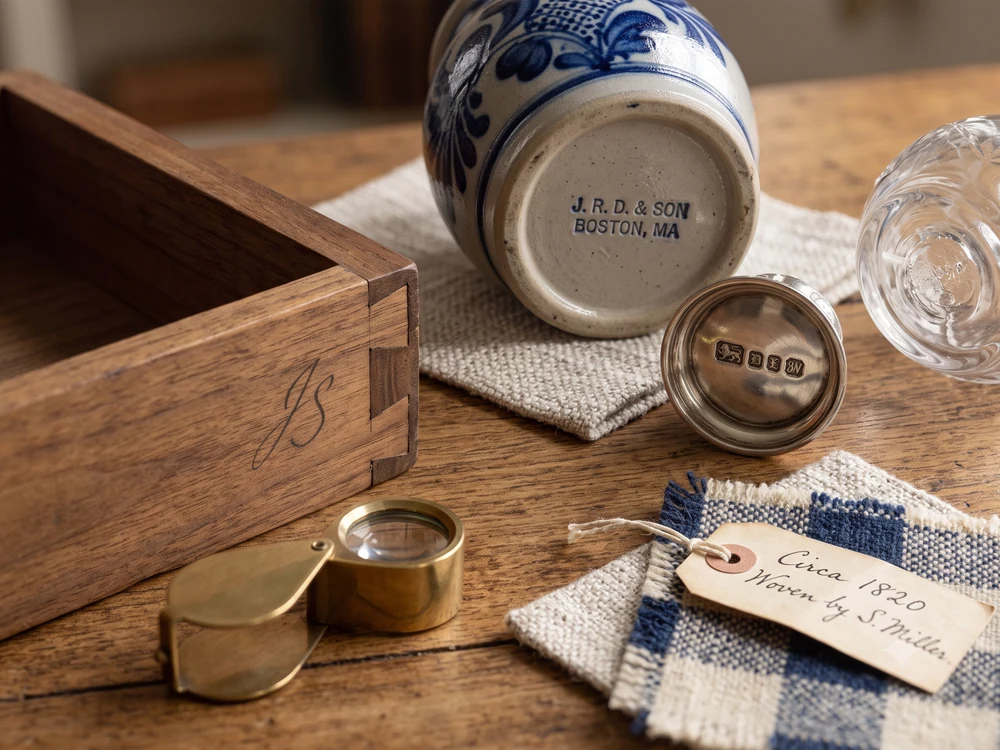
Photograph the stamp, cobalt, handles, base, clay and repairs before chasing a potter name.
Surface can preserve age, use, construction and repair evidence. Refinishing may erase more than color.
Fasteners move, repairs happen, and old parts get reused. Date the construction system, not a single clue.
Form, woods, construction, decoration, maker networks and provenance work together.
American buyers repeatedly revived older styles. The label Queen Anne or Colonial does not itself supply a production date.
A worked example using woods, construction, form, hardware and documentation.
Made, used, retailed, imported, adapted, or documented in America are different claims. Learn to state each precisely.
Identify, date, authenticate, preserve, and responsibly buy American furniture, folk art, pottery, silver, textiles, glass, tools, documents, and regional antiques.

Each guide begins with physical evidence, then moves to maker, region, period, authenticity, condition, provenance, and market comparison.
Case furniture, tables, seating, desks, beds, regional construction, woods, hardware, surface, and provenance.
Painted cupboards, dry sinks, benches, blanket chests, work tables, pie safes, and vernacular construction.
Carvings, painted objects, theorem paintings, fraktur, tramp art, memory ware, signs, and community-made objects.
Salt-glazed jugs, crocks, churns, cobalt decoration, kiln faults, maker stamps, and regional potteries.
Lead-glazed earthenware, slip decoration, sgraffito, utilitarian forms, repairs, and regional production.
Rookwood, Roseville, Weller, Grueby, Van Briggle, Newcomb, marks, glazes, shapes, and restoration.

Record dimensions, materials, construction, marks, surface, condition and provenance before searching for names. Strong identification explains why the evidence fits and what remains uncertain.
Queen Anne, Federal, Empire, Shaker, Victorian and Arts and Crafts are useful design languages. The actual object still needs material, tool-mark, hardware, surface and provenance evidence.
Ohio attribution is strongest when maker marks, family records, addresses, directories, newspapers, museum collections and physical evidence agree.
A state-level guide to Ohio furniture, pottery, glass, Shaker material, farms, industry, canals, river towns, and local provenance.
Crocks, jugs, churns, cobalt decoration, potter marks, river transport, clay districts, and repairs.
Roseville, Weller and other southeastern Ohio pottery traditions, marks, glazes, shapes, and restoration.
Ohio River commerce, urban cabinetmaking, labels, woods, regional forms, and documented shops.
Great Lakes trade, industry, furniture, silver, glass, advertising, civic institutions, and local makers.
State government, printers, furniture, household goods, local businesses, political material, and city provenance.
The marketplace finder builds focused eBay searches, but every listing still needs an independent originality, condition, completeness, provenance and shipping review.

Short, evidence-based lessons on surfaces, construction, regional attribution, estates, Ohio objects and market language.
Made, used, retailed, imported, adapted, or documented in America are different claims. Learn to state each precisely.
Surface can preserve age, use, construction and repair evidence. Refinishing may erase more than color.
Fasteners move, repairs happen, and old parts get reused. Date the construction system, not a single clue.
Form, woods, construction, decoration, maker networks and provenance work together.
Photograph the stamp, cobalt, handles, base, clay and repairs before chasing a potter name.
Labels, photographs, correspondence and objects can authenticate one another when kept together.